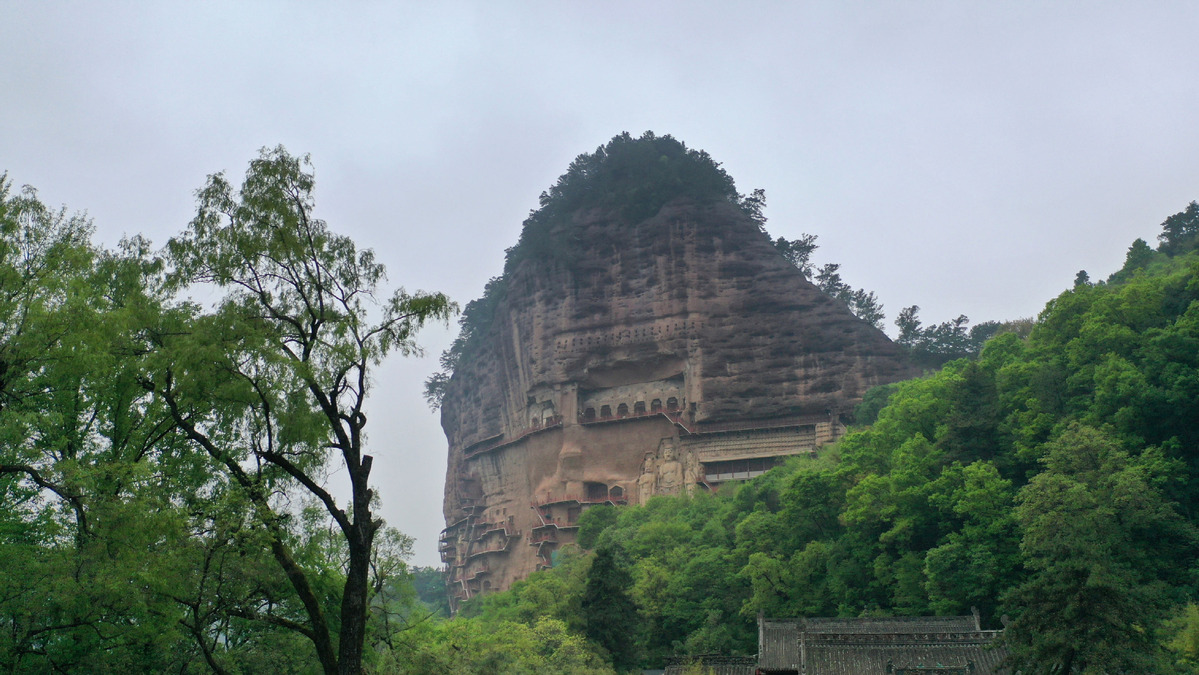
Maiji Mountain Grottoes
麦积山石窟
- 分类: 旅游
- ID: 1869583884288626694
Home CategoryTourismMaiji Mountain GrottoesPlay7 minsSituated 45 kilometers southeast of Maiji District in Tianshui City, the Maiji Mountain Grottoes are nestled in the forests of Xiaolong Mountain, north of the western extension of the Qinling Mountains.ShareLocated 45 kilometers to the southeast of Maiji district, Tianshui city, Maiji Mountain Grottoes sit in the forests of Xiaolong Mountain to the north of the west extension of Qinling Mountains. "Maiji" in Chinese means grain stack and the mountain got its name because of its resemblance to the shape of a stack of wheat. The mountain is formed by red sandy conglomerate and towers at 142 meters.
Surrounded by a group of lower mountains, Maiji Mountain stands out with steep cliffs on three sides. The grottoes were discovered on the red-gravel cliffs of the mountain 20 to 80 meters above the ground. "In the clouds and between the cliffs, stones were carved to make Buddha.
One cannot help but wonder if it is a work from heaven even if it is known that the thousands of grottoes were man-made." Dense grottoes and layers of interconnected plank roads on the cliffs make a marvelous spectacle in the history of ancient cave digging. Compared with its Chinese peers, Maiji Mountain Grottoes are representative works of those from the Northern Wei and the Northern Zhou dynasties. Known as the "Oriental Sculpture Exhibition Room", Maiji Mountain Grottoes mark the continuation and further development of China's Buddhist grottoes after the localization by the Yungang Grottoes.
As per written records and inscriptions from stone tablets, Maiji Mountain Grottoes were first carved from 384 to 417 A.D. (the Later Qin of the Sixteen Kingdoms of the Eastern Jin Dynasty) by "digging the mountains to make tens of thousands of statues on thousands of cliff surfaces and turn cliffs into Buddha pavilions". Through renovations in a dozen of dynasties (including the Northern Wei Dynasty, the Western Wei Dynasty, the Northern Zhou Dynasty, the Sui Dynasty, the Tang Dynasty, the Five Dynasties, as well as the Song, Yuan, Ming and Qing dynasties) over a period of more than 1,500 years, Maiji Mountain Grottoes now house 221 Buddhist grottoes dating back to the 5th to the 13th centuries. Specifically, apart from the 20 discovered in the Wangzi Grotto and the three empty ones found in the deposit of collapsed cliffs in the central section, all the rest 198 grottoes are carved on the eastern and western cliffs of around 120 meters long and 50 meters high (including 56 on the eastern cliff and 142 on the western cliff).
These grottoes are interconnected by 14-layer plank roads along the cliffs. Currently, there remain 12,182 statues preserved, including 7,886 clay statues, in addition to 1,065.2 sq m of murals and 18 stellai. Other relic buildings include the Ruiying Temple and the stupa. A total of 800 historic items and more than 1,500 volumes of Buddhist text and documents are housed.
The highest remaining Buddha statue in Maiji Mountain Grottoes is 15.33 meters high and the smallest one is less than 30 centimeters high, with those in Grottoes No. 4, 74, 78, 133 and 127 being the most representative. Most of the grottoes were carved during the Northern Dynasties, including 44% during the Northern Wei Dynasty, 6% during the Western Wei Dynasty, 21% during the Northern Zhou Dynasty, 5% during the Sui Dynasty, and the remaining 24% or so during other dynasties.
The current grottoes in Maiji Mountain were mostly made during a period from the Northern Dynasties to the Sui Dynasty. The earthquake and invasions of Tubo in the Tang Dynasty marked the end of the best days for the grottoes. Multiple large-scale renovations were launched from the Song Dynasty till the Qing Dynasty on the grottoes. The existing clay statues dating from the Northern Wei, the Western Wei, the Northern Zhou, and the Sui dynasties represent the best works of China's clay statue making in the 5th to the 7th centuries.
Clay statue making welcomed a comeback in the Song Dynasty, demonstrating the artistic achievements in the region in the 10th to the 13th centuries. The statues made in early years of the Northern Wei Dynasty embody the Pingcheng Model (also known as Yungang Model) of China's Buddhist grottoes and the implications from Indian art of Gandhara. The local features of Buddhist statue making art in the ancient Qinzhou region are also notable. Some unique statue-making and painting techniques used in Maiji Mountain Grottoes represent the features in the local Buddhist culture and arts. During the period from the late Northern Wei Dynasty to the Western Wei Dynasty, the statue-making style of Luoyang and the Southern Dynasties gains dominance in Maiji Mountain Grottoes.
Maiji Mountain, as a strategic western exit from Chang'an city to surpass the Longshan Mount on the Silk Road, acted as a transit station that sinicized the Buddhist arts and then transmitted the arts to the Western world.
The emergence of large sutra paintings and the content about China's traditional concept on "becoming immortal" had an impact on the art forms of Dunhuang Mogao Grottoes dating back to the middle of the 6th century and later. Maiji Mountain Grottoes feature a diversity of themes and styles in statue-making.
As Trikalea Buddhas, Seven-Buddha, Thousand-Buddha, Maitreya and Vimalakirti were popular from the Northern Dynasties through to the Sui Dynasty, a number of Trikalea Buddhas and Vimalakirti statues were made, evidencing the popularity of Mahayana, a translational work by Kumarajiva during his stay in Chang'an, in the region. Mahayana has become a key component of regional Buddhist belief in the region since then.
In 1961, Maiji Mountain Grottoes were listed among the first batch of key cultural relics units under national protection by the State Council. In June 2014, the World Heritage List made Maiji Mountain Grottoes a site in the listed heritage Silk Roads: the Routes Network of Chang'an-Tianshan Corridor.
Article reference1. Gansu on last push ahead of Cultural and Natural Heritage Day. chinaservicesinfo.com. 20222. Zhang Baoxi Biography. chinadaily.com.cn. 20193. Maiji Mountain Grottoes. chinadaily.com.cn. 2019Photo Gallery(14 pictures)CategoriesTourismTagWorld HeritageCultural LandscapeWorld Heritage in ChinaRelatedBingling TempleLongmen Grottoes, LuoyangGames & QuizzesGrotto Greats: How well do you know China's cave art?Catalogue-
- []








